This Saturday, Kodaly Music Educators of Kansas hosted Amy Abbott from Music a la Abbott in Wichita for our Spring KMEK workshop.
Over 60 teachers from Kansas and neighboring states attended Amy's session, "Say, Say, Oh Playmate," which was packed full of fun singing games for upper elementary. Those are the kids that I am always finding I am needing additional resources and games for, or maybe I just get bored of some of the ones I have... I don't know. Either way, this session was just what we needed to motivate us to keep the joy going in the music class as the end of the year draws near.
Amy has so graciously said I can share some videos that fellow KMEK members shared and I will try to cite where the songs come from.
I definitely recommend looking into these sources for more information as well as having your local Kodaly chapter invite Amy out. I can say that she was definitely among my favorite presenters! :)
Little Swallow - stick passing game
Source: 150 American Folk Songs
Epo I Tai Tai - performed in 4 part canon.
Source: Amy learned this song from Susan Brumfield. If you have a primary source, please let me know.
Source: Amy learned this from Kathy Hickey. If you have more source information, please let me know!
Cobbler,Cobbler (Pass the Shoe)
Source: Jill Trinka
Have you played any of these before? I hope you enjoyed a peek into our workshop. We definitely have some amazing things going on in Kansas. We hope you can join us in Wichita for MKMEA 2015 this October!
I know that one of the things I have tried to do more this year is provide more writing practice on known concepts during our lessons. I hope to blog more about this topic in the future as it is an on-going goal to continually do more with this. It such a great way for me to have a chance to really see who is getting the concepts, and who may need more help and support. It is also good for assessment and many districts are experiencing a huge push towards writing with the Common Core.
My kiddos have been practicing la so I pulled out this song:
Here's how we play the game. One student is "it" and sits facing away from the class. The class sings the first two lines and one student who I choose sings the last line as a solo. The person who is "it" must guess who is the mystery singer. This song is a great opportunity for me to hear individuals and squeeze in some solo singing assessment when they think I am just keeping track of turns. Sometimes when I have a squirrely class that may sing silly I do tell them that I am taking a pitch matching grade, but usually I don't need to.
After playing the game we go to the board and read the song with melodic icons like these. They sing on text first as I point to the pictures, then we sing on solfa with hand sings. Eventually the icons move onto the staff and we show where la would live if sol and mi are on lines or spaces.
Then, instead of printing out a worksheet for each student, we did this page together, projected onto the board. We focused in on the second measure only and I had individual students come up to the board and fill in the note heads. Once all the note heads were added, we then added the stems and beams. Doing this together as a class is really helpful for the students who need to see it modeled before doing something similar on their own.
If you are interested in the slides and printable/projectable worksheet that I used for "Johnny's It" you can find it here.
What are some of the most successful ways you incorporate writing in your music room?
I am so excited to announce a new series on my blog: Folk Song Friday! I can't commit to or promise that every Friday I will have a new post up, but when I can, I hope to post one of my students' favorite folk songs and share with you what I do with that song in my classroom.
Song of the Week: Let Us Chase the Squirrel
Hardest Rhythmic Concept: half note (ta-a or ta-o)
Other Rhythms: ta and titi
Hardest Melodic Concept: re
Other Pitches: d m sl
I have two different games that I play with this song.
Game #1: Students are in long ways sets, forming arches with their partner as the "trees in the forest". Whenever the teacher plays on the triangle, the two students at the end of the set duck down and run up the trees going through the arches and forming a new arch at the end. The sets can travel all around the classroom this way.
Game #2: Students are in groups of three around a circle. Two form a tree and one is the squirrel under the tree. Any leftover students go to the middle of the circle and are squirrels. On the word "tree" all of the squirrels must go to a new tree and the squirrels in the middle can try to steal a tree.
Here's a video of my students playing the second game:
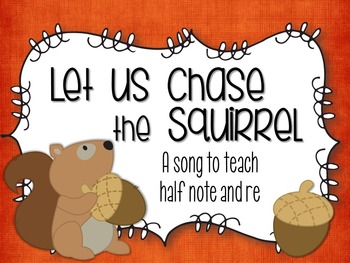
If you are looking for visuals for the song, I've redone my "Let Us Chase the Squirrel" file to give it a fresh look and include slides for re. It has gone from 12 pages to 67!
If you own this file:
It has now become this:
I project this page and have them tap along with the beat when I am working on half note prep. Eventually, the kids will find a sound that lasts for two beats.
I bring this song back out when we are working on the melodic concept, re. We play the game during re prep, and then after re has been presented, this song provides lots opportunity to practice re. On the slide below we would sing from icons on the staff.
Click on the pictures above to check it out if you are looking for complete ready-made visuals for this song or to re-download and get the updates for free if you had purchased the older version!
I am linking up today with Amy Abbott and several other music teachers to share some ideas for surviving the end of the school year.
TIPS #1: Keep them moving with singing games and folk dancing
Jump Jim Joe
This is the closest version I could find to the one I do with my kids.I use the recording from the Amidons and I have the inside circle move because it is a shorter distance to travel. When teaching a double circle dance, make sure you are always on the outside so that you can see everyone! This will eliminate a lot of problems.
Our Old Sow
I learned this game from Jo Kirk last summer and my kids LOVE IT!
TIP #2: Keep them "on track" and engaged in music learning until the end. I usually spend the last 2-3 weeks as review time to practice the concepts we got through that year as well as looking ahead to next year to prepare the upcoming concepts for the fall.
I've been using my "Race to the Finish Line" planning guide to keep myself and my kiddos "on track" from January through May.
(click the picture above to see it in my TPT store)
It includes song lists for each grade as well as an excel file for each grade that lays out the different concepts through the second half of the school year. Since it is in excel, it is totally editable. You can add song titles under each concepts, or move the concepts to a different month depending on where you are in your sequence.
TIP #3 Remember the good times!
Music should be a JOYFUL experience for your students. It is so much fun to take a moment and reflect on the experiences shared together in music. I created some "Music Memories" pages for each grade level so that I can see what they remember most about our year together, their favorite singing game, favorite piece we listened to and more. The packet is totally editable, so you can add your own questions if you think it is something you would be interested in using with your kids.
(click on the picture above to see it in my TPT store)
One more fun thing I wanted to share with you was the a bunch of music teachers will be teaming up for another $2Tuesday on TPT. Enter "$2TuesdayMusicFlashSale" in the search bar on TPT to see all of the hugely discounted items from some amazing TPT music teacher/authors.
The file from my store will be my melodic flashcards for preparing and practicing sol-mi.
(click on the picture above to see it in my store)
These flashcards are amazing resources for melodic transitions between songs. I could have a mystery song on the board like this:
Starlight Starbright
See Saw
I don't have cards for "2,4,6,8" but I had my kids construct it using the cards from the other songs. Then we added the rhythms above. Next time we will transfer to the staff.
The kit includes 164 flashcards designed to go with the following songs:
Bee Bee Bumblebee Blue Bird (1st measure) Come Back Home My Little Chicks Doggie, Dogggie (1st measure) Hey Hey Look at Me Lemonade Rain Rain Go Away See Saw Up and Down See the Old Witch Snail, Snail (1st measure) Starlight Starbright
Pitch is shown using: Icons only (can be used in the preparation stage) Icons w/ solfege Icons on staff Rhythm stick notation w/ solfa (where rhythms are appropriate) Icons on staff with solfa Standard notation with solfa inside note head
What are your tips for surviving the end of the school year?
I think I got really lucky at some point and found this on ebay for about $50. Yikes! I didn't even know what a gem it was at the time! If you ever see this book, snag it. It will be worth it!
This book is jam packed full of singing games in any formation you can think of and it sequences them not by melodic/rhythmic concept, but by movement concepts, which I think is really neat.
Obviously I am not going to try a square dance or cicilian circles with my kindergartners, but this offers a variety of different kids of dances and gives you and idea of what grade level it might be appropriate for. So many of these singing games and dances will fit right into your concept plans, but some are great just to do for FUN even if they melodically/rhythmically to difficult to read for your students.
One of the songs that I pulled recently for some more ta rest practice is singing game called "Cut the Cake".
Here's a quick demonstration video of some of my kids playing the game. I wish I wouldn't have sung along, I was sick and sound terrible. Great reminder to let your kids sing alone, Lindsay! During phrase one students clap hands, phrase 2 we shake, phrase 3 everyone in the circle grabs hands, phrase 4 "it" slices the "cake" and holds out both hands. Where ever "it" sliced the cake, those two students race in opposite direction around the circle and tag "it's" hand when they get back. The first one to tag "it's" hands becomes the new "it" and the game starts over. You need to talk about safety before you start this game. When the two people are running in the opposite direction they will pass each other at some point. They need to watch out for the other person. In my room, if they bump into each other, the game is over. The kids love to play the game, so they are really careful not to bump into each other.
After we have played the singing game we go over to the board and I have this slide projected:
We pat the beat in our laps as we sing and identify that the party hats are showing us the steady beat.
If I am in the preparation stage of ta rest, I show this slide where the hats with rests look different because they are a gray or "empty" looking. Students quickly see that they are like that because there are no words underneath them. We practice tapping and clapping the rhythm (the "way the hats look").
Once ta rest has been presented, we can use this song for practice and try reading the rhythms with their rhythm syllables and making no sound on the rests.
In level 3 we worked on creating musical transitions from one song to the next to make our lessons seamless. I love to use a rhythmic transition from this song to "Pitter Patter" which I first found in one of John Feierabend's books. I play the "eraser game" transforming "Cut the Cake" into "Pitter Patter" by erasing beats 3 and 4 of the 1st and 3rd line and changing them to ti-ti's. The 2nd and 4th lines stay the same!
I've just finished another bundled set of materials! You can check out the Songs and Materials to teach tika-ti bundle here.
I am trying to get my 4th and 5ht graders caught up on the Kodaly Sequence, but it is definitely a process since reading rhythms and solfege is brand new to them. I am hoping to present tika-ti by the end of the year (eek, we are getting down to the wire!).
Here are some fun songs and resources from my collection for tika-ti (or whatever you call it in your rhythm language).
Here's a short sample of one PDF slides from one of the songs:
Presenting tika-ti! (I also made slides to say tiri-ti, tipi-ti, ta-ka-di, duda-de) Let me know if you have yet another way to say this rhythm and I would be happy to make revisions to fit your rhythm language
I also have a very fun rhythm game and printables that are included in this set.
I will begin by saying I am NOT the expert on older beginners. I was only in my second year of teaching when I started at a new school with grades 1-5 where the teacher before me was not a Kodaly inspired teacher and music literacy was not a priority. When I came into this school my students had no method of counting rhythms and had never heard of solfege. I had just completed my level 1 training and during my first year teaching I only saw grades K-2 so the upper grades were pretty new to me. I knew I wanted to teach them music literacy and I also knew there was no way I was going to accomplish this with songs like "Starlight, Starbright". I started searching for best practices for teaching older beginners.
I looked for games they would love and ways to trick them into singing. My first year I really devoted to learning to read rhythms and getting used to singing beautifully without the crutch of CDs or piano. This year we have really taken a dive into melodic concepts starting with mi-re-do and I think thet are surprised by what they are now able to read and analyze!
I think a good starting place is one that lays a foundation for future concepts through games, nurtures the singing voice, anddevelops a sense of steady beat.
I have also found that m-r-d is a better starting place for older beginners than sol-mi since more of the age appropriate music begins and ends with m-r-d.
I am sure there are other teachers out there with similar situations, whether they are in a new school or just starting to take their levels training, so I compiled some of my kids' favorite songs and activities for those basic concepts. I know I would have really loved to have these resources when I started out!
I have included 6 songs like the following and activities that I have done with my older beginners.
I have also included 26 slides for the song "Mighty Pretty Motion". It can be found in 150 American Folk Songs to sing read and play. My kids really enjoy the game that goes with it.
After we've played the game several times and we are getting close to presenting sol, I show them this:
(They think my hula dancers are funny!)
(repeats 2 more times)
(three times)
We could look at it on the staff:
back to the staff:
This packet for older beginners is available on my teachers pay teachers store here. It is by no means a complete comprehensive method for older beginners but more of a tool or starting place with ideas that you can build upon.
Comment below if you have other great ideas for older beginners! I am always looking for things to do with my 4th and 5th graders until we are "caught up".
If you have any questions about this or any of my other posts or products on TpT please email me at LindsayJervis@hotmail.com