menu   home About Me My Classroom Guest Post Workshops Guest Post
Showing posts with label 2nd Grade. Show all posts

Thanksgiving Week {Take a Peek at my Week}

Looking for some ideas for your elementary music classes in the days or weeks leading up to Thanksgiving?


1) Ho Ho Watanay - I used this song with kindergarten and first grade this week. In kindergarten it was perfect timing as we are practicing loud/soft and introducing the term "lullaby". We also tapped on the feathers to the feel of the music (preparing the steady beat). In first grade, we review the beat tapping page, but then take it a step further and look at the rhythm of the song. It is great ta and titi practice. We play the rhythms on hand drums as we sing.

You can find slides for the song "Ho Ho Watanay" here. This file teaches loud/soft, lullaby, prepares and practices steady beat, prepares/practices rhythm of the words and ta/titi.

2) Children's Literature for Thanksgiving in the Music Room
I introduce the song "Ho Ho Watanay" with the book "Northwoods Cradle Song". I sing the song on the page turns following every page that reads "Sleep, little warrior, sleep. Go to sleep. Go to sleep." I have looked all over for a song or melody to go with this book from the Menominee tribe, but have not found one yet. Ho Ho Watanay is actually an Iroquois lullaby, but because of the theme of the book and song, I pair them together.


I used the book, "One Little, Two Little, Three Little Pilgrims" last week with kindergarten. They enjoyed comparing the lives of the pilgrims and Indians in the book. 


I love to use the "I know an Old Lady..." books. I have several of them and they may great "fill in the blank" books as Jo Kirk would call them. I sing most of the book, but give the students a special part to sing, in this case the "perhaps she'll die". Thank goodness she doesn't die in this book. She just inflates until she becomes a balloon in the Thanksgiving Day parade. Hopefully none of us eat that much over Thanksgiving! ;)

3) Pumpkin Patch Rhythm Compositions
I had to be gone a couple days this month, so I left this "Pumpkin Patch Rhythm Composition" activity for a few classes while I was gone. It was easy for them to do while I was away, gave them more practice writing and working with a specific set of rhythms. I had them do these compositions with a partner and then on a later day, they combined with another pair and taught the other pair their composition and created one long composition out of the two that was 16 beats. The group of four then performed them for the class when I was there, so I was able to use it as a composition and performance assessment and assess two different skills. Working with a partner and then teaching their composition to another pair was really neat to watch. I could tell that because they were writing, manipulating, and teaching it, they really "got it". 


4) Turkey Trot Rhythm Races
My kids love rhythm races. They are fun and competitive. I love that it gives me a chance to see which kids really are getting it. I divide the class into teams. My classes have about 25 kids, so I do five teams with 4-5 kids on each team.

The teams stand in lines next to their team color turkey. I read/clap/or play a rhythm and one player from each team races to the other end of the room. When they get there, they see piles with turkeys of their team's color. They must locate the correct rhythm and bring it back to their team. The first team to bring back the correct rhythm gets 2 points. If they bring back a correct rhythm, but they are not first, they get 1 point for their team. If they bring back an incorrect rhythm, they get 0 points and they have to go take it back because they will eventually need to find that rhythm.

(Photo shared from the classroom of Shelley Potter).


I hope you have enjoyed a peek at my week and some of the things I am doing right before Thanksgiving!


Writing in the Music Room


I know that one of the things I have tried to do more this year is provide more writing practice on known concepts during our lessons. I hope to blog more about this topic in the future as it is an on-going goal to continually do more with this. It such a great way for me to have a chance to really see who is getting the concepts, and who may need more help and support. It is also good for assessment and many districts are experiencing a huge push towards writing with the Common Core.

My kiddos have been practicing la so I pulled out this song:

Here's how we play the game. One student is "it" and sits facing away from the class. The class sings the first two lines and one student who I choose sings the last line as a solo. The person who is "it" must guess who is the mystery singer. This song is a great opportunity for me to hear individuals and squeeze in some solo singing assessment when they think I am just keeping track of turns. Sometimes when I have a squirrely class that may sing silly I do tell them that I am taking a pitch matching grade, but usually I don't need to.

After playing the game we go to the board and read the song with melodic icons like these. They sing on text first as I point to the pictures, then we sing on solfa with hand sings. Eventually the icons move onto the staff and we show where la would live if sol and mi are on lines or spaces.


Then, instead of printing out a worksheet for each student, we did this page together, projected onto the board. We focused in on the second measure only and I had individual students come up to the board and fill in the note heads. Once all the note heads were added, we then added the stems and beams. Doing this together as a class is really helpful for the students who need to see it modeled before doing something similar on their own.  


If you are interested in the slides and printable/projectable worksheet that I used for "Johnny's It" you can find it here.

What are some of the most successful ways you incorporate writing in your music room?

Folk Song Friday {Let Us Chase the Squirrel}

I am so excited to announce a new series on my blog: Folk Song Friday! I can't commit to or promise that every Friday I will have a new post up, but when I can, I hope to post one of my students' favorite folk songs and share with you what I do with that song in my classroom.


Song of the Week: Let Us Chase the Squirrel

Hardest Rhythmic Concept: half note (ta-a or ta-o)
Other Rhythms: ta and titi

Hardest Melodic Concept: re
Other Pitches: d m sl

I have two different games that I play with this song.

Game #1: Students are in long ways sets, forming arches with their partner as the "trees in the forest". Whenever the teacher plays on the triangle, the two students at the end of the set duck down and run up the trees going through the arches and forming a new arch at the end. The sets can travel all around the classroom this way.

Game #2: Students are in groups of three around a circle. Two form a tree and one is the squirrel under the tree. Any leftover students go to the middle of the circle and are squirrels. On the word "tree" all of the squirrels must go to a new tree and the squirrels in the middle can try to steal a tree. 


Here's a video of my students playing the second game:


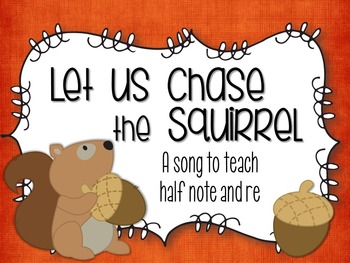
If you are looking for visuals for the song, I've redone my "Let Us Chase the Squirrel" file to give it a fresh look and include slides for re. It has gone from 12 pages to 67!

If you own this file:
 Let Us Chase the Squirrel
It has now become this:


I project this page and have them tap along with the beat when I am working on half note prep. Eventually, the kids will find a sound that lasts for two beats.


I bring this song back out when we are working on the melodic concept, re. We play the game during re prep, and then after re has been presented, this song provides lots opportunity to practice re. On the slide below we would sing from icons on the staff.


Click on the pictures above to check it out if you are looking for  complete ready-made visuals for this song or to re-download and get the updates for free if you had purchased the older version!


Grab a FREE sample of this song file here. 


Do you have any other ideas, games, books, or visuals you use with "Let Us Chase the Squirrel"? Collaborate by sharing below in the comments!

Yearly Planning for Music Teachers


My first year teaching (during my pre-Kodaly training days) I planned for each day and and no real long term vision for my classes or from year to year. During my Level 2 training, Lisa Simmelink really helped me understand concept and long range or yearly planning. One of our assignments was to map out concepts for the whole year for one grade level.

Every music teacher wants to get their year started off on the right track, reviewing where they left off with each grade level and getting new students caught up to speed.  From there we hope to stay on track progressing through the musical concepts we have planned for that grade level. In addition to that, we are thinking about our music programs and performances and how that all fits in to our yearly calendar and planning.  Having a plan in place helps to guide my planning for the whole year. 

So let's get started with yearly plans. When I do long term planning, I like to start with yearly plans and break it down by month, just looking at concepts. What do I want my students to be practicing by that month? Will I be preparing any new concepts? Will I be presenting a concept? Make sure that you are always working both melodically and rhythmically in every lesson. Go month by month for each grade level deciding about how long you will spend preparing/practicing each concept. Remember to be flexible!

Here is a sample of what my long range planning looks like. This is for kindergarten from August through December. I make different colors for different concepts (pink for Kindergarten concepts, yellow for rhythmic concepts, blue for melodic concepts, and the older grades also include scale and meter). I separate by month across the top and the light shades of each color represent concepts that are in the Practice stage (known concepts), while the darker shades represent the concepts that are being prepared and presented.


Want to see more?

These templates are samples from my planning sets on TPT which includes both yearly plans and song lists by concept for each grade level.


Getting from Yearly Plans to Lesson Plans Once you have the concepts you want to teach for each month and each grade level, make song lists for each grade level. Make a list of all the concepts you included on your Monthly/Yearly plans for that grade level (I’ve started one for you for each grade level, but you may need to adjust it to fit your needs). Under each concept heading make a list of all the songs you plan to use while working on that concept. That way when I are look ahead to my third grade planning in September I can see I want to be practicing re and tiri-tiri and preparing ti-tiri, then I would go to my third grade song list and find a song list for ti-tiri to find songs under that concept to weave my lesson plan together.

Here's a sample of what my first page of my 3rd grade song list looks:
For the little kids I like to have a ton of songs/games/activities in each lesson (probably 7-10) in a 30 minute lesson. For the older kids, I choose less song materials per lesson, but go deeper with the songs. Plus by then, their songs are a bit longer. 

Want a closer look at my "Ready, Set, Plan" yearly planning set? Check out this video:


Do you have different strategies for long term planning? I'd love to hear them in the comments below!


Music Room Organization {Part 1: Digital Files}


Let's face it! Music teachers have a LOT of STUFF! Our rooms are full of instruments, sound equipment, puppets, books, manipulatives and that doesn't even scratch the surface of keeping everything organized on our laptops!

On my Facebook page, I asked for some topics to blog about and one teacher requested that I write a post on how I keep all my visuals organized and ready to use without wasting too much down time!

For today's post, I am strictly going to show some ways that I (try to) keep organized so that I can quickly find what I need for each class, especially when you have classes with zero break in between and so that there is as little down time as possible DURING the class. I don't know about you, but I only see my kids for 30 minutes twice a week- each second counts!

To start off with I have anything and everything that I would ever need at school all saved to an external hard drive.

I bought two of them on sale during Black Friday.

I have several reasons for doing this, and it may or may not be something you want to look into. 

1) If anything should happen to my computer, I can take this and hook it up to ANY computer. I've had to borrow my PE teacher's laptop for a day when mine decided not to work. Having all my files stored on an external hard drive was a life saver and meant that I could continue on with my lessons as planned.

2) It gives me a permanent back up of all my files that I create or download from other TPT music teachers. (I also store many things on dropbox and google drive). I'm just SO terrified of losing my things.

3) I store a TON of clip art that I use to make all of my files, so I really need a lot of storage space.


To start off with, I save to that hard drive in one main folder with several sub folders.

Click to enlarge


Within this main teaching folder are many, many sub folders organized by concepts. I also have a big one titled "Songs" which I will explain in a minute.

So, say I am working on my lesson planning for teaching half note, I pull up my half note folder and it has ALL of my digital files for that concept.

Click to enlarge.


I start by going to my concept plan.
Click to enlarge.

(snapshot taken from my concept plan for half note, available in my Songs and Games to Teach Half Note) Here I have outlined all of the songs I can use and I make a column that says teaching materials where I list any resources I have created (or collected) that I don't want to forget. I haven't made visuals for all of the songs on the repertoire list, so I make a note of what songs I do have those digital visuals ready to go.

I use my concept plans, my notes from my Kodaly Certification, the American Methodology and Yearly Plans while writing my own plans, but this organization on the digital end helps me figure out what songs/activities I can plug where. If you don't have those materials, I highly suggest you look into them. Another thing that you might find helpful in your long term planning is my Jan.- May Planning Guide

It includes song lists by grade level as well as rhythmic and melodic concepts mapped out for when I plan to prepare, present and practice them (from Jan-May). I hope to make another set before back to school for Aug.through Dec.

Once I have my plans done, and the school day is upon me, how do I transition between files for each class/grade?

In the morning I see 4th, 3rd, then 5th, so I go to my lesson planner before school and I see what digital files I will need for the morning, and have them all pulled up so they are ready to go and I can quickly move from one to the next while my kids are singing.

If they are all songs, an easy way I have found is to have a folder that has all my song visuals. I just go to that folder and type in the song title and poof! There it is! That way I don't have to dig through all my concept folders. 

Song File contains ALL my song visuals in ABC order
Click to enlarge.

Quickly find what I need by typing in the title.

Click to enlarge.


At lunch I close out of all my 3rd-5th files and open all my 1st and 2nd. 

How to transition during/between classes:

Since all my files that I need for a class are already open, all I have to do to transition between files, is hover over the PowerPoint of PDF icon at the bottom of my screen, depending on what kind of file it is, and select my file. I always try to do this when my kids are busy doing something else. Say we were at the board to read and clap the rhythm for "Who's That Tapping At Your Window?", then we went to the circle and played the game, as my kids are going back to the board and I am transitioning to the next song (and file) I can have them sing "Who's That?" and assign soloists or if the next song is one they know well by memory, I have have them sing it while I pull up the slide. They are not sitting there waiting for me because it takes them more time to get to their spot than it does for me to switch files, and I can quickly make the switch to Rocky Mountain.
Click to enlarge

I hope this helps give you some ideas on how to organize your digital files. Later this week, I hope to blog about getting manipulatives organized for each class period.

If you have different/more efficient ways of organizing digital files, PLEASE feel free to share! :) We can all learn from each other! Either comment or link up below!


Monday Music Manipulatives


Welcome to another Monday Music Manipulatives Link Up! This time I am so excited that my friend, Mia, is going to be my guest blogger to share some of the great manipulatives that she uses in her music room. Mia went through all three Kodaly Levels with me at Wichita State University, and we are both working on our Masters together. She is so passionate about teaching music and inspiring her students! I just know they adore her! If you want to link up and share some of your music manipulatives, feel free to join at the bottom of this post and please be sure to give Miss Nightingale a warm welcome to the blogging world! :)

Hello! My name is Mia Nightingale and I teach K-5 music in Wichita, Kansas. This month begins my 4th year teaching. I am blessed to have been hired right after student teaching at the school where I student taught. I completed my Kodaly certification just this last summer from Wichita State University along with Lindsay. My Kodaly teachers (Mrs. Jo, Lisa Simmelink, Susan and Royce Tevis, Gabor Viragh, and Shawn Chastain) are my biggest inspiration and I can undoubtedly say I am pretty much obsessed with each of them.

I am so excited and honored that Lindsay asked me to be her guest blogger! When she asked me to do my blog about some manipulatives I use in my classroom, my response was, “What if nearly all my manipulatives are your creations I bought on your TPT?!” Ha!! Even the ones I am going to talk about today are not my original ideas – I steal all my ideas from other fabulous Kodaly teachers! J

Today I am blogging about a couple manipulatives I used last week for 1st/2nd grade rhythmic and melodic dictation.
For rhythmic dictation: Each student had a plastic baggie with 12 colorful Popsicle sticks. I played 4 beat patterns with rhythm sticks this week using the rhythms ta titi and ta rest.  The students form the rhythms with the sticks.


The first time I ever do this, I do have them “figure out with me” how we can make the ta titi and ta rest (trickiest) with the sticks. It is important for me to mention that when I play the pattern, I say “beat, beat, ready here I go” or simply “beat, beat, beat, beat” and move my sticks from their left to right with each beat as I play for visual aid. By the way, you don’t have to just use popsicle sticks. I have also made a set of cut up colorful straws that I used this week, too, that work almost better than popsicle sticks because they are smaller and take up less room. 


( As you can see in the pictures, my students have assigned seats on the floor. My honor choir is the only group I ever use chairs with.)


For melodic dictation: I have laminated staff paper (lined on one side – blank on the back) and use small colorful “chips” that the students place on the staff. (I got these chips from the Instructional Support Center downtown).  I start with 4 chips each, and eventually will use up to 8 each. 


What I do not have pictured here is my smartboard where I have projected my own staff paper. I always do the first couple with them. Also on my staff paper that is being projected, I draw the do clef and sometimes change where do will be this time. I sing or play the melody being dictated. The first time we ever do melodic dictation, I sing in solfege the first couple of times. Then I use a glockenspiel to give them a visual aid. When I know they’re ready, I sing melody on “loo” or play at piano. Also, after a couple weeks of doing dictation with the colorful “chips”, I pass out dry erase markers and they can use those instead to draw their own noteheads and add stems. After everyone has marked their answer, they help me do mine that is being projected on the smartboard.


Trying to understand a young child’s handwriting / music notation writing skills can be quite the challenge.  I have found that using these manipulatives can give a clearer assessment of what the student understands and hears before having them write it down.  Feel free to comment below with any questions or suggestions you might have for me!

Mia Nightingale


"Teach music and singing at school in such a way that it is not a torture but a joy for the pupil; instill a thirst for finer music in him, a thirst which will last for a lifetime." --Zoltan Kodaly

How to link up
1. Write a blog post on your blog titled Monday Music Manipulatives. Include my Link Up picture with a link back to my blog
2. Add your link below so that other music teachers can find you!
3. Don't forget to pin to pinterest so people find it!

Making Musical Transitions

When I first started teaching I had no concept of musical transitions. I would simply move from one activity to another. Often during this time the kids would get off task waiting to see what the next activity was going to be. During level 1, I got to see how the fabulous Jo Kirk would weave her songs together through stories and though I am not as creative as she is, I began to create stories to connect the songs I was using with my first and second graders. After my Kodaly Levels 2 and 3, I feel like am better at making MUSICAL transitions.

A musical transitions will guide your students throughout your entire lesson, connecting songs with melodic and rhythmic activities. These should never be drills, but simply a way of getting from point A to point B.

Here are some examples of melodic transitions using the melodic element "fa" and the songs,  "Twinkle, Twinkle Little Star" transitioning to "Chairs to Mend"

Students sing "Twinkle Twinkle Little Star" on solfa with hand signs.


Teacher then shows 4 or 8 melodic flashcards. Here's the key. They are NOT FOR DRILL! The flashcards should be purposefully selected, not just "let's do a stack of flashcards". The first flashcard should have some tonal pattern from the song you are coming from and ending with a tonal pattern of the song you are going to. In between are tonal patterns of known songs. I would write down the exact tonal patterns I was going to use in my lesson plans including what songs they are from so that I could have all my visuals ready.

Here's how it would look: 
(pattern from "Twinkle Twinkle"

(pattern from "This Old Man")

(Pattern from "Are You Sleeping?/Brother John")
(pattern from "Chairs to Mend")


Which leads right to our next song! Sing on text then add canon:


Another way to get from songs with similar tone sets would be to use a tone ladder. Taking the same two songs, you could first sing "Twinkle Twinkle" then point to the pitch ladder having students sing on solfa with hand signs. You could do the whole song, then move to song fragments from other known songs ending with your starting phrase of the next song in your lesson. Your tone ladder could be projected onto the board like this:


Or you could use cut outs like these:


Rhythm transition activities:
Another rhythmic transition that could be used here would be flashcards. Again, the use of the flashcards is not for drill, but to guide us from one song quickly to the next for a seamless transition with no wasted time.

I could start with:

(from "Chicken on a Fence Post")

(From "Dinah")

(From "Golden Ring Around the Susan Girl")

(From "Old Brass Wagon")

And off you go with singing "Old Brass Wagon" and performing the square dance!

One of my goals for the upcoming school year is to work on including more musical transitions like these for grades 2-5. What other kinds of transitions do you use? What are your goals for the upcoming school year?

If you like the transition resources I have used in this post, they are all available at my Teachers Pay Teachers Store:

Fa Melodic Transition Staff Cards {FREEBIE}

Tone Ladders (Over 50 Pages of tone ladders that you can project or cut out and put on your board)


Rhythm Flashcards - Available by concept or in a Mega Set-The ones I used in this post were from my tiri-tiri (or tika-tika, takadimi, etc.) set